The Most Poisonous Plants of 2025. A Favorite Vegan Treat.
The Botanical Garden in Hamburg has once again announced the winner of the 2025 Most Poisonous Plant of the Year competition. What may come as a surprise is that the award went to popular nuts that can be found on the shelves of almost every grocery store in Poland and that often end up on our tables. However, if they are not prepared properly, they can have serious health consequences. Check whether you are eating them.
Table of contents:
- Most Poisonous Plant of the Year 2025 – results announcement
- Why did cashew nuts win the title?
- Are the cashew nuts sold in shops safe?
Most Poisonous Plant of the Year 2025 – results announcement
For over two decades, the Botanical Garden in Hamburg, known as Botanische Sondergarten Wandsbek, has been organizing a competition aimed at educating the public about plants growing in our homes, gardens and public spaces. Although many of them are remarkable for their beauty and beneficial effects on health, they can also display dangerous properties that tend to be underestimated or ignored.
Every year, experts compile a list of plants with toxic effects, after which voting determines the „winner”. According to the rules of the competition, a given plant can be nominated only once every five years, and a plant that has already won cannot compete for the title again in subsequent editions.
In the past, this title has gone, among others, to parsley seeds and the green parts of the potato – including sprouting tubers – as well as to the decorative but highly toxic wisteria.
Laureates of the 2025 competition:
- Cashew tree (Anacardium occidentale)
- Peony (Paeonia)
- Guelder rose (Viburnum opulus)
- Scarlet pimpernel (Anagallis arvensis)
- Rubber tree (Ficus elastica)
Why did cashew nuts win the title?
In 2025, the title of „Most Poisonous Plant of the Year” went to cashew nuts, which most of us know as a tasty and healthy snack. These nuts come from the cashew tree (Anacardium occidentale), native to the tropical regions of South America, especially northeastern Brazil. Today, the cashew tree is cultivated in most countries in the tropical zone.
The fruit of the cashew tree has two parts: the so‑called cashew apple (an enlarged part of the stem) and the actual cashew nut, which is found in a hard shell.
Although the cashew nuts sold in shops are safe, problems arise when you come into contact with the raw seeds. Unroasted cashew seeds and their shells contain cardol – a toxic oil that can cause severe irritation of the mucous membranes. Eating raw cashew nuts leads to acute abdominal pain, and contact with the shell of the fruit can trigger painful allergic skin reactions resembling second‑degree burns.
Are cashew nuts from the shop safe?
If you think that all, even trace amounts of toxins that are present in raw form in these nuts are completely eliminated in the cleaning, roasting and drying process carried out in third‑world countries, then you are being overly optimistic.
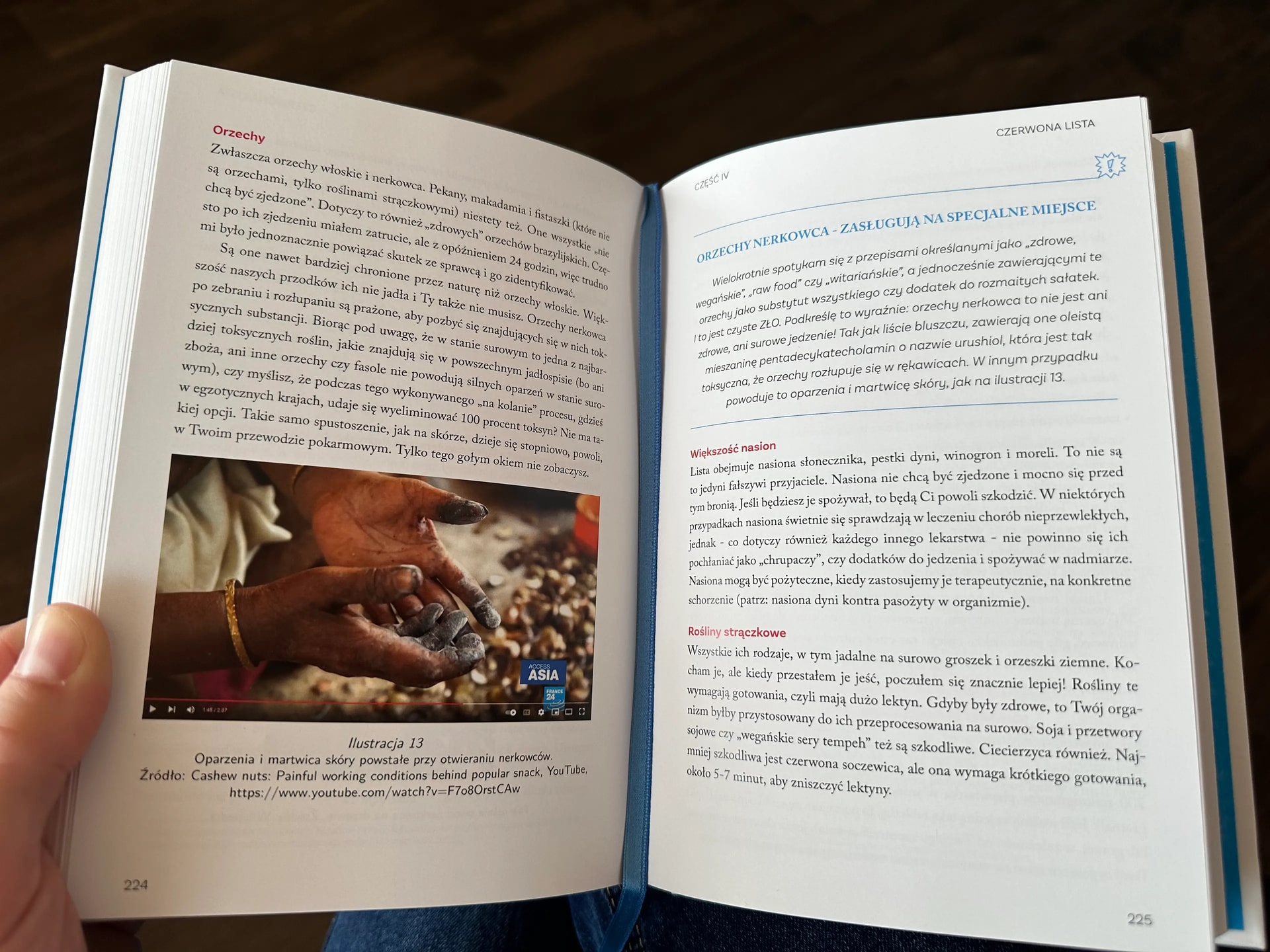
I warn against eating cashews if you have any digestive or allergic problems or chronic diseases, and especially if you have RA (rheumatoid arthritis). This is described in detail in the book „How I Cured the INCURABLE” («Jak wyleczyłem NIEULECZALNE»), even in the first edition from 2023. I’m pasting a photo of an excerpt from my book on this topic.
If you’re interested in more such health nuances that many people are unaware of, and in learning about the most effective possible methods to cure difficult chronic cases, I recommend buying the book available here: JakWyleczylem.pl : Książka