Hi everyone,
I wanted to share with you an analysis of a case involving a patient struggling with a hard‑to‑heal wound infected with staph (a complication after surgery for a ruptured Achilles tendon). Below is a summary after the first 6 sessions in a hyperbaric chamber. You’ll find lots of useful information here on the physiology of wound healing, optimal pressures, breaks in therapy and the choice of dressings. I think this knowledge can help many of you facing a similar battle!
Origin of the condition
The patient ruptured her Achilles tendon. She had surgery at a private clinic (Reha Sport), where she developed a staph infection. As a result, an open wound formed on the lower leg, down to the bone. The client underwent several months of antibiotic therapy and the wound partially healed, but for the past two years it has remained unchanged, pushing her to the limits of her endurance. She decided to try hyperbaric oxygen therapy at the suggestion of her new attending physician (an orthopedist).
Initial assessment of therapy progress (Day 1 vs. Day 6 of treatment)
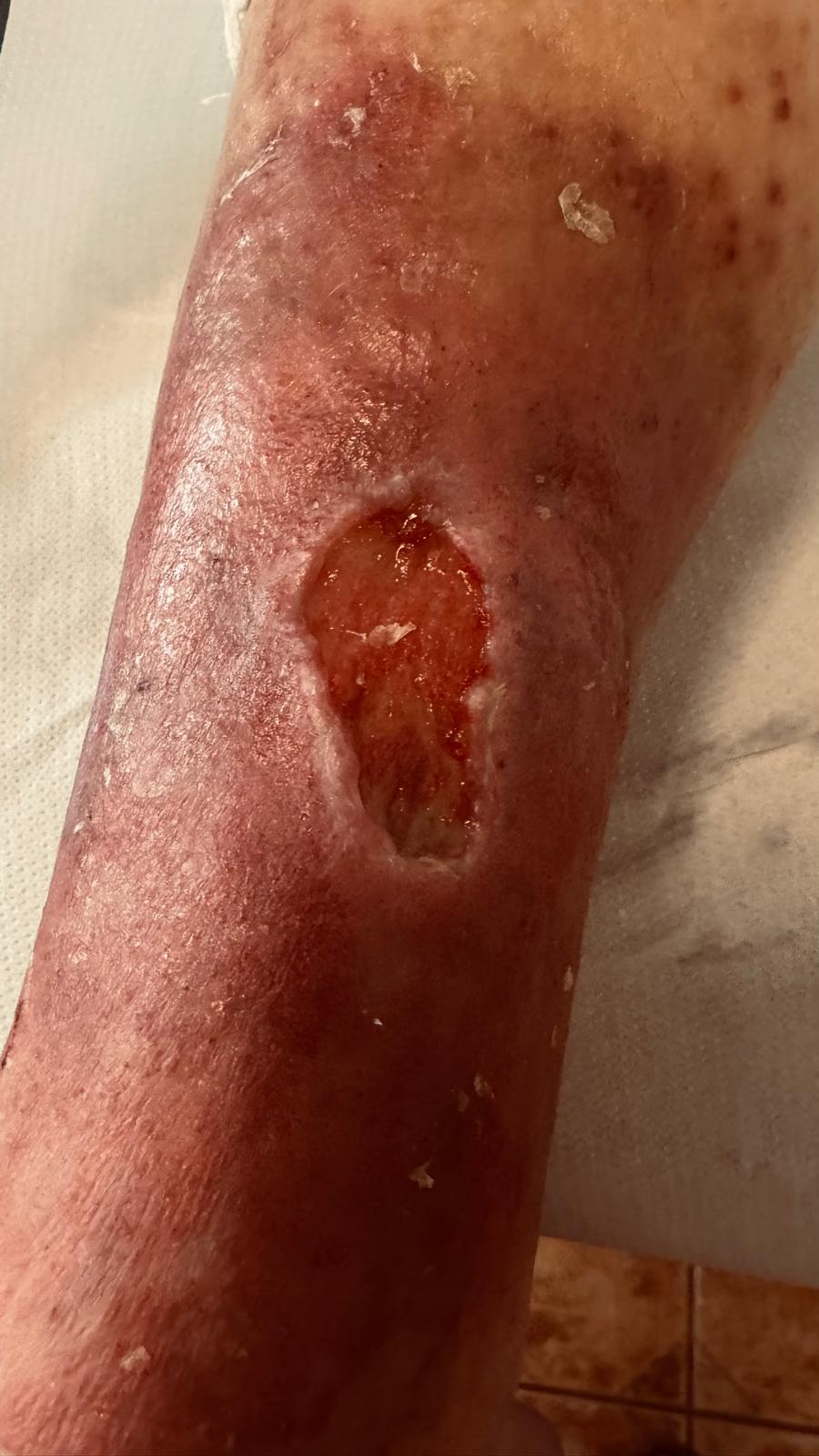
This is what the wound looked like before the start of therapy and how it had remained for two years despite all sorts of dressings (silver, hydrogel, etc.):
This is what the wound looks like after 6 days of hyperbaric therapy at 2.5 ATA for 120 minutes:
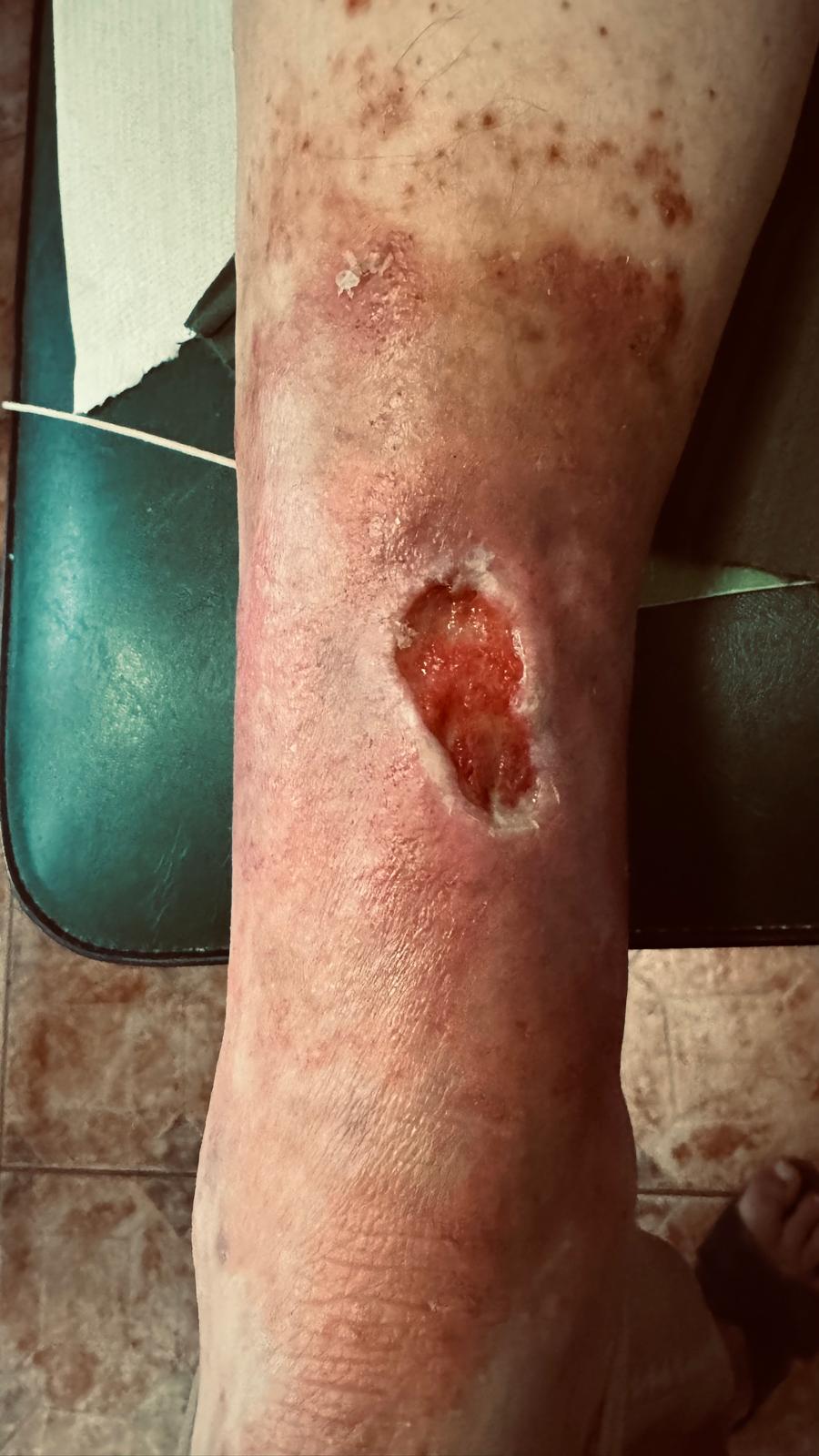
Personally, I’m impressed, but… the patient is not happy. She expected that the wound would at least close.
In my opinion, however, when you compare the photos from the start of therapy and after 6 daily 120‑minute sessions, you can clearly see positive progress. The wound bed has cleaned up nicely, and the appearance of fresh red tissue (so‑called granulation tissue) is an excellent sign – it suggests that the body has started to effectively fight the infection and that new blood vessels are rebuilding well. It may seem that the circumference of the wound isn’t shrinking yet, but this is a completely natural process. The defect first has to “fill up” with new tissue from the bottom before the skin can start to grow in from the edges.
What does the lightening of the skin around the wound mean?
The change in color around the wound indicates a modification of the tissue environment, which is necessary for proper healing to begin. It reflects three processes:
-
Resolution of hypoxia (lack of oxygen): Bluish or dark skin often indicates deep ischemia and an accumulation of deoxygenated blood. Oxygen delivered under high pressure dissolves in the plasma and effectively bypasses damaged capillaries, reaching hypoxic areas. The tissues regain better oxygenation and with it a lighter, healthier color.
-
Reduction of inflammation and edema: Redness (erythema) around the wound is a classic sign of chronic inflammation and/or hypoxia. Hyperbaric oxygen has a strong anti‑inflammatory effect, causing, among other things, vasoconstriction (without reducing oxygenation), which reduces swelling and suppresses inflammatory erythema.
-
Improvement in microcirculation: Restoring drainage of exudate and toxins from the intercellular space allows the periwound skin to regain its proper structure.
Why hasn’t the wound diameter decreased yet?
The healing of chronic wounds is a cascade process, and epithelialization — the growth of new epidermis and closure of wound edges towards the center — is the final stage of that process. Before the edges can start to come together, the body has to rebuild the “foundation” of the wound:
-
Inflammatory phase: This is just coming to an end, as evidenced by the improvement in color around the wound.
-
Angiogenesis (formation of new blood vessels): At this stage, oxygen stimulates fibroblasts to produce collagen and initiates the building of a new capillary network at the wound bed.
-
Granulation: The wound must first be filled from below with new, healthy tissue (granulation tissue). If the defect is deep, the process of “lifting” the bed up to skin level takes many weeks.
-
Epithelial migration: Only when the wound bed is filled with granulation tissue and the inflammation at the edges has completely subsided do epithelial cells get the signal to migrate and close the defect — that’s when the wound diameter starts to decrease.
Chamber parameters and duration of treatment
A chamber running at 2.5 ATA with 120‑minute sessions provides the best possible results. This is currently the safest and most effective setting for supporting the healing of this type of wound and for fighting bacteria.
Increasing the pressure (e.g. to 3.2 ATA) would not speed up the process, so staying at 2.5 ATA is the best option. It’s important to remember that the first 10 sessions are only the initial phase. According to standards, in advanced cases like this patient’s, it is recommended to perform between 20 and 40 treatments for full tissue regeneration.
How long can the breaks between sessions be?
In practice, breaks shouldn’t be longer than 2 days. This stems from two key medical points:
-
Prolonged oxygen stimulus (about 48–72 hours): Hyperbaric therapy triggers a cascade of cellular reactions, the most important of which is stimulation of macrophages to release growth factors that build a new capillary network. This effect has a kind of “inertia”. For about 48 to 72 hours after the last session, cells in the wound are still working intensely. After that, the process slows and the tissues return to a hypoxic state. A break longer than 2–3 days halts angiogenesis, and the newly formed vessels may regress.
-
Fighting staph and leukocyte activity: Hyperbaric oxygen has bactericidal and bacteriostatic effects, “supercharging” leukocytes so they can effectively kill bacteria. If we deprive tissues of high‑pressure oxygen for more than 48 hours, immune defense drops. Staph (especially if a biofilm remains at the wound bed) then gets a perfect window of opportunity to proliferate again, undoing earlier progress.
Supportive treatment suggestions (dressings and diet)
To optimize the entire treatment process, it’s worth introducing the following steps:
-
Changing the wound environment: Hydrogels are good when a wound is dry, but when there is exudate, they can over‑moisten an infected wound. With heavy exudate, this contributes to softening (maceration) of the skin edges. At this stage, it’s worth trying dressings that absorb excess fluid and contain silver ions. Examples include: Aquacel Ag or Atrauman Ag (for the wound bed) and Kaltostat (an alginate dressing that handles heavy exudate very well).
-
Protecting irritated skin: Redness around the wound is often the result of a reaction to the adhesive in tapes and the irritating effect of the exudate. It’s best to stop using adhesive dressings in favor of non‑adhesive foam dressings (Non‑Adhesive versions, e.g. Allevyn Non‑Adhesive or Biatain Non‑Adhesive), which can easily be held in place with a bandage. The skin can be protected from moisture with a barrier spray (so‑called “artificial skin”, e.g. Cavilon 3M or Secura).
-
Frequency of dressing changes: As healing progresses and the amount of exudate decreases, the time between dressing changes should be extended to 3–4 days. Changing dressings too often can mechanically damage delicate, newly formed granulation tissue. Remove the dressing and apply a new one immediately if:
-
Exudate is leaking through to the outside.
-
The foam dressing is completely saturated and heavy.
-
There is a sudden, very unpleasant odor.
-
The dressing has slipped and exposed the wound.
-
-
Dietary support: It’s worth considering two meals a day, for example within a 6‑hour eating window. It is essential to add as many fresh fruits rich in vitamin C to the diet as possible – such as fresh oranges, berries, blueberries. Fruit is the best natural multivitamin, and the vitamin C it contains is essential for healthy skin repair and collagen synthesis.
-
Continued surgical care: Regular mechanical debridement of the wound with a scalpel by a physician is an excellent measure that works perfectly in tandem with oxygen therapy.
The role of insulin in healing (A word of caution about low‑carb diets and fasting)
Some patients adopt strict elimination diets (e.g. extreme low‑carb or eating once a day), hoping that completely cutting out sugar will speed up healing. On a restrictive, no‑carb diet, insulin levels remain flat. Wound cells simply don’t have the “workforce” to pull in the building materials circulating in the blood.
I’m personally a fan of fasting as one of the most effective holistic healing methods. You have to be very careful with it, though, in the case of hard‑to‑heal, infected open wounds. Fasting will clean such a wound and may even remove the infection, but once the wound is clean it will slow the actual closure process.
In the world of weight‑loss diets insulin has a terrible PR image, but from the perspective of wound healing it is the most powerful anabolic (building) hormone in the entire body. It acts like a biological “forklift”. When we eat protein, it enters the bloodstream, but for amino acids to get inside wound cells and build new tissue, the body needs a physiological spike of insulin to physically “push” that material inside.
This absolutely doesn’t mean provoking unhealthy, sharp glucose “spikes” (e.g. from sweets), which damage blood vessels, but rather sensibly stimulating insulin release at least twice a day. The best way to provide the body with healthy carbohydrates is multivitamins in the form of fresh fruit (oranges, berries, blueberries). They will trigger the necessary insulin response and at the same time deliver a powerful dose of vitamin C, which is absolutely essential for collagen synthesis.
Would I personally use fasting for my own hard‑to‑heal wound?
Scars, scratches and old lesions (Autophagy in practice)
Here the reports are enthusiastic. People are massively posting photos and descriptions of how during 3‑, 5‑ or 7‑day water fasts their old scars (for example postoperative) become shallower, fade, and skin problems (psoriasis, eczema) completely disappear. This is commonly attributed to autophagy – when the body has no external food, it “eats” damaged proteins and excess scar tissue.
Fresh, deep and open wounds (After surgery or injury)
For open, large wounds (like in the patient described), reports from forums paint a completely different, much more cautious picture.
-
The “frozen wound” phenomenon (stalling): This is the most common account. Users with open wounds or after tooth extractions notice that during a water fast the wound literally freezes in time. The pain stops, swelling and redness disappear right away (the anti‑inflammatory effect of fasting), but physically the defect does not close. Skin and granulation tissue do not grow.
-
A burst of healing after refeeding: The same people very often report that the real “magic” happens only when they break the fast and start eating again (especially high‑protein, nutrient‑dense meals). They notice that a wound which “stayed the same” for 5 days of fasting can close within 48 hours of resuming food intake.
-
Lack of a “scab” / Drying out: Many people report that during fasting, strong scabs do not form on fresh superficial wounds. The wound becomes very “clean” and dry, but lacks the sticky exudate and building material that usually physically seals a wound.
-
Community warnings: When someone posts on r/fasting: “I had an accident/surgery yesterday and have a big wound, should I fast to speed up healing?”, the most experienced long‑term fasters (those who do 20–30 days on water) advise against it in 90% of cases. A popular saying in those communities is: “Fasting is for cleaning, feeding is for healing”. They point out that after an open injury the body needs building material, not starvation.
I hope this compendium clears up the doubts of many people struggling with similar problems. I’m keeping my fingers crossed for all patients!